Vowels
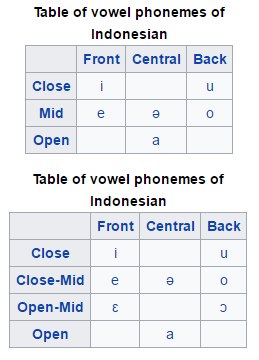
NOTE: These pages use Bahasa Malay terms where Betawi terms are not known.
It is usually said that there are six vowels in Indonesian. These six vowels are shown in the table above. However, other analyses set up a system with other vowels, particularly the open-mid vowels /ɛ/ and /ɔ/.
Diphthongs
Some analyses claim that Indonesian has three native diphthong phonemes only in open syllables, they are:/ai̯/: kedai ('shop'), pandai ('clever')
/au̯/: kerbau ('buffalo')
/oi̯/ (or /ʊi̯/ in Indonesian): dodoi, amboi
Others assume that these "diphthongs" are actually a monophthong followed by an approximant, so 'ai' represents /aj/, ⟨au⟩ represents /aw/, and ⟨oi⟩ represents /oj/. On this basis, there are no phonological diphthongs in Indonesian.
[43]
Diphthongs are differentiated from two vowels in two syllables, such as:
/a.ʔi/: e.g. rayakan ('celebrate') [ra.ʔi], air ('water') [a.ʔer] (or [a.ʔɪr] in Indonesia and [a.ʔir] elsewhere) /a.ʔu/: bau ('smell') [ba.ʔu], laut ('sea') [la.ʔot] (or [la.ʔʊt] in Indonesia and [la.ʔut] elsewhere)
Sources:
Clynes, A (1997). "On the Proto-Austronesian 'diphthongs'". Oceanic Linguistics. 36: 347–362. doi:10.2307/3622989.
Soderberg, C. D.; Olson, K. S. (2008). "Indonesian". Journal of the International Phonetic Association. 38: 209–213. doi:10.1017/s0025100308003320.
Wikipedia
Yunus Maris, M. (1980). The Indonesian Sound System. Kuala Lumpur: Penerbit Fajar Bakti Sdn. Bhd, page 2.